
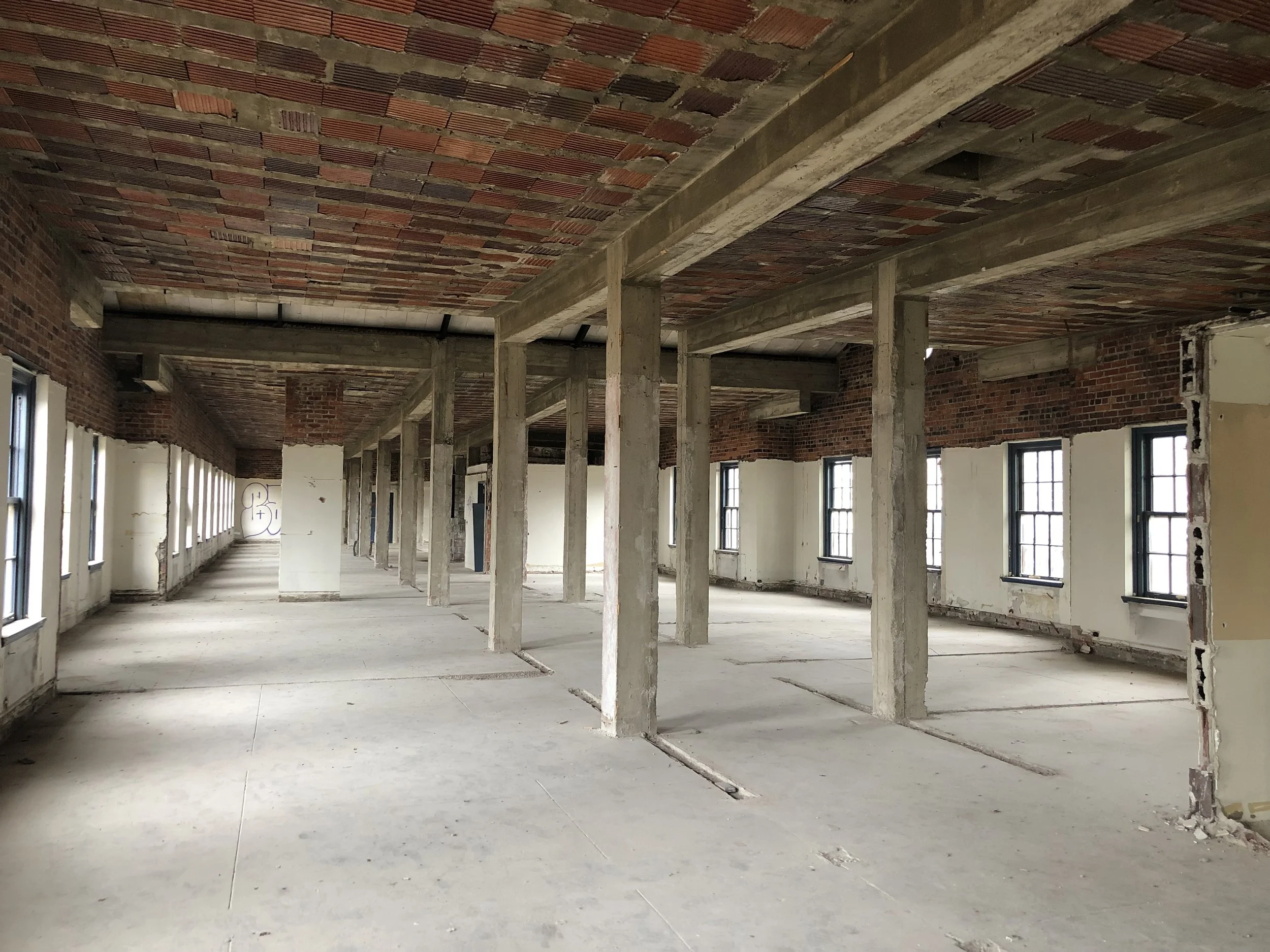
Old buildings have more soul.
Adaptive reuse is the art of making old buildings work for the future. It means working with what exists — improving it, keeping it efficient and safe, and helping it continue to serve a purpose long into the future. Old buildings present unique challenges: repairing or replacing historic windows, managing asbestos or lead, meeting energy code requirements, and satisfying accessibility standards. We know how to navigate all of it.
There's a misconception that old buildings must be "brought up to code" in ways that make renovation prohibitively expensive. The truth is more nuanced. The International Existing Building Code (IEBC) offers multiple compliance pathways designed specifically to make renovation feasible. We know how to work within this code, engage with building officials early, and avoid unnecessary expense — whether the issue is environmental abatement, energy compliance, or structural upgrades.
Reusing an existing building is also vastly more sustainable than building new. The embodied carbon savings of adaptive reuse is typically 50–75% compared to new construction. Many older buildings also have significant thermal mass that performs exceptionally well in Colorado's climate — when renovated properly, they can operate as efficiently as a new building with far less insulation.
Existing buildings often exceed what current zoning would allow to be built today. Tighter stairs, narrower corridors, compact floor plates — features that let them maximize usable space in ways new construction simply can't replicate.
Our adaptive reuse experience spans building types and scales. At Boettcher Concert Hall, we are managing a $2.5M electrical systems upgrade within one of Denver's most prominent performing arts venues. For the Colorado Cattlemen's Association, we renovated 4,200 SF of office space within the historic Livestock Exchange Building, weaving a new mechanical system carefully into the existing fabric of the space. At a 1900 Classical Revival residence in Congress Park, we are overseeing a comprehensive renovation including asbestos abatement, extensive masonry restoration, basement excavation, and entirely new MEP systems throughout.
We use a LiDAR scanner to survey existing buildings with exceptional accuracy in minutes — replacing manual surveying methods that once took weeks.